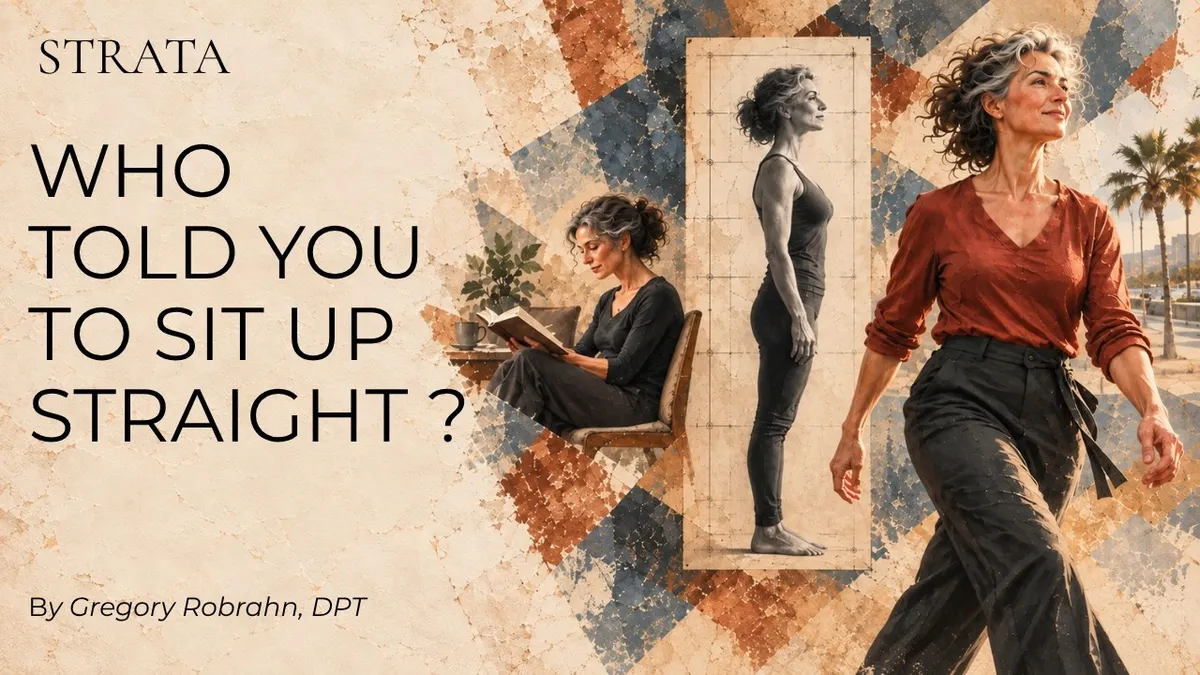
Is Slouching Bad for You? Who Told You to Sit Up Straight?
Have you ever caught yourself slouching and immediately pulled your shoulders back? Perhaps someone told you to sit up straight because your posture looked unhealthy.
We've learned to associate upright posture with good health and slouching with future problems.
But what if we've been judging posture by how it looks rather than by what it allows us to do?
Watch the full lecture
Key Takeaways
Slouching does not automatically cause pain, and sitting upright does not guarantee healthy function.
Posture provides information about how someone is positioned, but appearance alone cannot establish a diagnosis.
Effective posture involves organizing the body for a task with stability, efficiency, and adaptability.
Having more accessible movement options may matter more than maintaining one supposedly perfect position.
Why Were We Taught to Sit Up Straight?
We've been telling people to sit up straight for generations.
Children. Patients. Ourselves.
Shoulders back. Head up. Stop slouching.
We can look across a room and decide almost instantly whose posture is good and whose is bad.
But confidence and accuracy are not the same thing.
Our judgments about posture have a surprisingly complicated history.
We describe an honorable person as an upstanding citizen. Someone considered lazy may be called a slouch.
For generations, uprightness was associated with discipline, strength, and good character.
A soldier standing at attention projects discipline and control. But standing at attention isn't necessarily an efficient strategy for lifting a suitcase or working in the garden.
Historian Beth Linker explores these cultural assumptions in her book Slouch: Posture Panic in Modern America.
She documents how American institutions, particularly during the twentieth century, became preoccupied with identifying and correcting supposedly poor posture.
Schools examined children's bodies. Posture standards and competitions encouraged people to conform to prescribed physical ideals.
We developed an image of what posture should look like, then often treated deviations from that image as defects.
But here's the distinction I want you to consider:
A difference in appearance isn't necessarily a defect in function.
The way someone looks while sitting or standing doesn't tell us everything about how their body works.
Does Slouching Actually Cause Back Pain?
Imagine two people sitting in chairs.
The first sits upright, head centered, shoulders pulled back.
The second sits with a rounded upper back and shoulders resting slightly forward.
By conventional standards, the first person appears to have better posture.
But what can we actually conclude from that picture?
We cannot determine who has less pain, who can comfortably reach overhead, or who can get down on the floor and stand back up.
We know how they're positioned.
We don't yet know what they can do.
Posture is a sign, not a diagnosis.
Quick clip: Can You Judge Posture Just by Looking? (0:57)
A person's posture may provide useful clues about strength, fatigue, structural characteristics, discomfort, or protective behavior.
But those observations require context and, when appropriate, professional evaluation.
Research also gives us reason to be cautious about assigning pain to a particular posture.
In a 2020 study published in the Journal of Biomechanics, Christopher Swain and colleagues examined 41 systematic reviews investigating spinal posture, physical exposure, and low back pain.
The researchers found inconsistent relationships and no scientific consensus establishing that particular spinal postures or physical exposures cause low back pain.
That doesn't mean posture, tissue loading, or physical demands never matter.
They can matter considerably, depending on the person, task, duration, and circumstances.
But it challenges the assumption that someone who slouches is necessarily damaging their spine.
And it reminds us that appearance alone is not a reliable substitute for understanding function.
What Is Good Posture Really Supposed to Accomplish?
Consider something ordinary.
You're standing in your kitchen talking with a friend.
Without consciously controlling every joint, your body maintains balance and keeps you upright.
Now imagine reaching for a cup on the counter.
Your weight shifts. Your trunk moves. Your arm extends.
Move that same cup to a low shelf, and your body faces a different task.
You bend, shift your weight, and reorganize your movement to reach the cup.
Same person. Same cup.
Different task. Different postural solution.
That's what posture helps us accomplish.
It organizes the body to meet the demands of an activity.
Now imagine reading comfortably in a chair.
Someone tells you to sit up straight.
You lift your chest, pull your shoulders back, tighten several muscles, and begin consciously monitoring the position.
You're no longer simply reading.
You're performing posture.
That additional effort may be useful for certain tasks, but it isn't automatically necessary for sitting comfortably.
I describe unnecessary physical effort and conscious monitoring as a control cost.
Some activities require considerable stability, force, and attention. Others don't.
Movement skill involves meeting the demands of a task without unnecessary effort.
Think about a concert pianist.
Their hands move across the keyboard with remarkable speed and precision.
Now imagine arranging a beginner's hands in precisely the same position.
Perfect finger placement. Perfect appearance.
Does that mean the beginner can play the music?
Of course not.
You can copy the position without possessing the skill.
And that's an important distinction when thinking about posture.
Why Postural Fluency Matters More Than a Perfect Position
I use the term postural fluency to describe the ability to organize your body appropriately for different tasks.
Think about fluency in language.
Someone who speaks fluently doesn't repeat one perfect sentence.
They have a vocabulary that allows them to respond to different situations.
Movement works similarly.
Postural fluency involves three interconnected abilities:
Stability: Maintaining the control needed for a task.
Efficiency: Using an appropriate amount of effort.
Adaptability: Changing your strategy when circumstances require something different.
That doesn't mean constantly changing position or avoiding upright sitting.
It means having choices.
You might feel comfortable walking along your familiar route but find uneven ground challenging.
Perhaps sitting in your favorite chair is easy, but getting down on the floor feels uncertain.
You may be capable in familiar situations while having fewer options when your environment changes.
Injury, pain, illness, changes in strength, or limited opportunities for practice may contribute to those restrictions.
And as movement options become less accessible, participation in meaningful activities can also become more difficult.
You may stop gardening, traveling, or getting down on the floor with your grandchildren.
Not because those activities no longer matter.
But because you're uncertain whether you can comfortably and confidently perform them.
Skill isn't about changing all the time. It's about being able to change when you need to.
Quick clip: Good Posture Is Not a Position. It’s a Skill. (0:55)
Now return to our two people sitting in chairs.
The first looks perfectly upright but struggles to bend, turn, or rise.
The second looks slightly slouched but can comfortably sit tall, reach, turn, and stand.
The first person appeared to have better posture.
The second demonstrated greater movement capability for those particular tasks.
The difference was invisible until they moved.
Try This: Notice What Your Posture Allows You to Do
During an ordinary, comfortable activity this week, notice how your body organizes itself.
You might be reading, sitting at your desk, or reaching for something on a counter.
Consider three questions:
1. Am I comfortable? Notice whether you're using more effort than the task seems to require.
2. Do I have options? Observe whether you can comfortably change position when you want to.
3. Can I adapt? Consider how your body responds when the task changes.
There's no need to force a particular position or challenge a painful movement.
Simply notice the relationship between the task and the way your body organizes itself.
The goal isn't to identify one perfect posture.
It's to become more aware of your available movement choices.
The Bottom Line: Good Posture Is a Skill
At STRATA, our movement education and coaching studio serving Sarasota and Lakewood Ranch, I encourage people to think beyond how their posture looks.
A person can appear perfectly aligned and still have difficulty performing everyday tasks.
Another person may look less upright while demonstrating excellent mobility, control, and adaptability.
We shouldn't confuse appearance with capability.
For generations, we've encouraged people to hold positions that look correct.
But holding a position and possessing the skill to use it are not the same thing.
Good posture is not a position. It's a skill.
It's the ability to organize your body for the task, with stability, efficiency, and adaptability.
That's postural fluency.
And here's what I want you to remember:
The problem isn't necessarily the posture you're in. It's whether you can comfortably and confidently get out of it when life requires something different.
Because the real measure isn't simply how you look.
It's what you can do next.
Related STRATA Lectures
The Trap of Trying Not to Hurt: How protective behavior may gradually restrict meaningful activities.
What If Your Body Learned to Hurt? How previous experiences can influence movement strategies and anticipation.
Explore Your Movement Possibilities
If you'd like to better understand how your body moves and explore ways to develop greater stability, efficiency, and adaptability, I invite you to schedule a STRATA Movement Discovery Session.
Book your Movement Discovery Session →
STRATA — HURT LESS. MOVE BETTER.
40 Sarasota Center Blvd., Suite 104, Sarasota, FL 34240. Call (941) 377-0111 or visit https://thestratamethod.com/
References
Linker, B. (2024). Slouch: Posture Panic in Modern America. Princeton University Press. https://doi.org/10.2307/jj.7657710
Swain, C. T. V., Pan, F., Owen, P. J., Schmidt, H., & Belavy, D. L. (2020). No consensus on causality of spine postures or physical exposure and low back pain: A systematic review of systematic reviews. Journal of Biomechanics, 102, 109312. https://doi.org/10.1016/j.jbiomech.2019.08.006
Disclaimer: For general education; not medical advice. STRATA provides movement education and coaching, not individualized medical diagnosis or treatment. Individual needs and physical capabilities vary.
