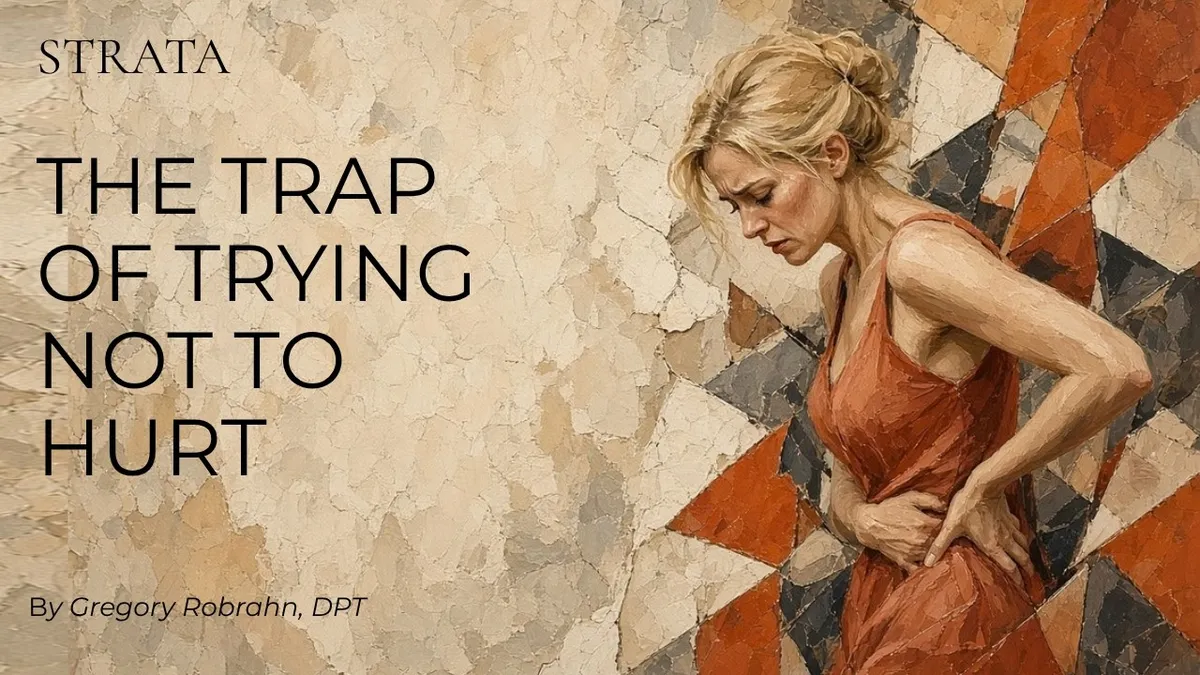
Can Avoiding Pain Make Things Worse? The Trap of Trying Not to Hurt
Have you ever stopped doing something you enjoy because you were afraid it might hurt? Perhaps you stopped lifting, exercising, gardening, or spending time doing something physically demanding.
Avoiding discomfort may have brought immediate relief. But over time, you may have noticed something else: the number of things you feel comfortable doing has become smaller.
What if the strategy you've been using to protect yourself is also beginning to limit your life?
Watch the full lecture
Key Takeaways
Avoiding painful movement can provide relief and may sometimes be medically necessary.
When fear drives persistent avoidance, the activities we feel comfortable doing can gradually decrease.
Pain-related restrictions can begin influencing confidence, participation, and even how we imagine our future.
The goal isn't to ignore pain. It's to explore safe, meaningful ways to preserve and rebuild capability.
Why Does Avoiding Pain Feel Like the Right Decision?
Imagine bending over to pick up your keys and experiencing sudden back pain.
The next morning, you try bending again, and the pain returns.
Naturally, you become more cautious.
You stop bending as far. You ask someone else to carry the groceries. Perhaps you decide to skip your usual exercise.
And when you avoid those activities, something happens.
You experience relief.
That relief matters. Your nervous system has an important responsibility to help protect you from potential harm.
Sometimes avoiding or modifying activity is exactly the appropriate response, especially during an acute injury or when a medical condition requires precautions.
But here's where things become interesting.
Relief can make avoidance feel successful, even when continued avoidance is no longer necessary.
In behavioral psychology, this is an example of negative reinforcement: a behavior becomes more likely because it removes or reduces something unpleasant.
You avoid bending. The discomfort doesn't occur. Avoiding bending now seems like a good decision.
The next time you anticipate discomfort, you're more likely to avoid bending again.
Not because you're weak or unwilling.
Because the strategy appeared to work.
The problem is that immediate relief and long-term improvement are not always the same thing.
How Can Fear of Pain Make Your World Smaller?
Researchers have studied this phenomenon through what is known as the fear-avoidance model.
The model helps explain how fear of pain or injury can influence behavior, particularly in some persistent musculoskeletal pain conditions.
Consider how the process might develop.
You experience pain during an activity.
You begin worrying that repeating the activity could cause harm.
To reduce that concern, you avoid it.
Avoidance brings relief, reinforcing the decision.
Quick clip: Pain → Fear → Avoidance → Relief (0:18)
But now you have fewer opportunities to discover whether the activity remains as threatening as you expect.
Over time, additional activities may begin to feel uncertain.
First, you stop bending.
Then you avoid lifting.
Later, you stop exercising or participating in activities you previously enjoyed.
Eventually, decisions about what you will and won't do may become organized around the possibility of pain.
Your world can begin to shrink—not necessarily because your body has lost every capability, but because fewer activities feel available to you.
This isn't inevitable. Not everyone with persistent pain develops significant fear or avoidance.
And some restrictions are necessary because of injury, illness, or genuine physical limitations.
But when fear is driving unnecessary restrictions, it deserves attention.
The cost extends beyond movement.
You may lose opportunities for recreation, social connection, independence, and meaningful participation.
What began as an attempt to protect yourself can start affecting how you live.
When Does Pain Begin Changing How You See Yourself?
There's another dimension to persistent pain that I believe deserves careful consideration.
Sometimes our restrictions begin influencing how we understand ourselves.
Imagine someone who has always enjoyed being physically active.
They identify as a golfer, gardener, traveler, or someone who enjoys playing with grandchildren.
But as pain-related restrictions accumulate, those activities become less frequent.
Gradually, their language may begin changing.
"I used to do that."
"I can't do those things anymore."
"That's just not who I am now."
These statements may accurately describe their current circumstances. But they may also reflect uncertainty about their future capabilities.
Research examining identity and chronic pain suggests that pain can become intertwined with how people imagine their present and future selves.
In some cases, valued activities begin to seem possible only if pain completely disappears.
This creates a difficult situation.
The person's sense of possibility becomes dependent on a condition they may not fully control.
I find it useful to think about a possible progression:
An experience becomes an expectation. An expectation becomes a rule. And a rule may begin shaping identity.
This is not a universal sequence, nor does it suggest that someone can overcome every limitation through positive thinking.
But it raises an important question.
Have you begun treating a restriction that developed during a difficult period as a permanent definition of what you're capable of doing?
Perhaps your circumstances have changed.
Perhaps new strategies are available.
Perhaps some activities can be modified rather than abandoned.
The purpose isn't to deny your present limitations.
It's to avoid assuming that today's limitations must define every possibility tomorrow.
How Can You Move Forward Without Simply Pushing Through Pain?
If avoidance has become restrictive, the solution isn't to disregard pain.
Nor is it to force yourself through increasingly difficult activities.
That approach can be inappropriate and, under some circumstances, harmful.
Instead, I encourage a more thoughtful question:
What might be possible under different conditions?
Suppose someone has stopped gardening because bending feels uncomfortable.
Their only perceived options may be to garden exactly as they did before or stop gardening entirely.
But there may be alternatives.
They might explore different tools, working heights, positions, activity durations, or ways of organizing the task.
The goal is to identify meaningful options that are appropriate for their circumstances.
When fear of movement is a significant barrier, qualified healthcare professionals may use approaches such as graded exposure.
Graded exposure involves carefully approaching feared activities and comparing expected consequences with actual experiences.
The objective isn't necessarily to eliminate all discomfort immediately.
It's to support new learning about an activity and the person's ability to engage with it.
Small, achievable experiences may also help strengthen self-efficacy—the belief that you can perform a particular action.
And that belief often develops through experience, not reassurance alone.
Sometimes progress means moving more comfortably.
Sometimes it means trying a previously avoided activity.
Sometimes it means discovering an alternative strategy that allows you to participate in something meaningful.
Success is not always the absence of discomfort. It may be the recovery of meaningful options.
Quick clip: The Way Forward Isn’t Just Courage. It’s Evidence. (1:19)
Try This: Notice What You've Stopped Doing
Take a moment this week to consider an activity you've reduced or abandoned because of pain or concern about pain.
Ask yourself three questions:
1. Why did I stop? Was it medical advice, a physical limitation, discomfort, fear of injury, or a combination?
2. What does that activity mean to me? Consider what you're missing beyond the movement itself.
3. Have my circumstances changed? Is this restriction still necessary, or would it be worth reviewing with an appropriate healthcare professional?
You don't need to test the movement or challenge a medical restriction.
Simply recognizing the reasons behind an avoided activity can be a useful first step toward a better-informed conversation.
The Bottom Line: Protection Should Serve Your Life
In my work at STRATA, our movement education and coaching studio in Sarasota, I encourage people to look beyond individual exercises or isolated movements.
What matters is how movement supports participation in life.
Protection is valuable. Sometimes it is essential.
But protection is intended to help us navigate challenges—not automatically become the organizing principle of everything we do.
If avoiding pain has gradually meant avoiding more of your life, it may be worth reconsidering which restrictions remain necessary and what possibilities are still available.
Quick clip: When Protection Stays Too Long (0:24)
The goal isn't simply to avoid what hurts. It's to preserve the ability to participate in what matters.
Because ultimately, our objective is not movement for its own sake. It's to help you:
Keep doing what you love, longer.
Related STRATA Lectures
When Pain Turns Up the Volume: Why more pain doesn't automatically mean more tissue damage.
What If Your Body Learned to Hurt? How previous experiences can influence protective movement patterns.
Ready to Explore Your Movement Possibilities?
At STRATA, we help people better understand how their bodies move and develop movement skills, confidence, and adaptability through individualized education and coaching.
If you're interested in exploring your movement capabilities, I invite you to schedule a STRATA Movement Discovery Session.
Book your Movement Discovery Session →
STRATA — HURT LESS. MOVE BETTER.
Serving Sarasota and Lakewood Ranch, Florida. Call (941) 377-0111 or visit https://thestratamethod.com/
References
Vlaeyen, J. W. S., & Linton, S. J. (2000). Fear-avoidance and its consequences in chronic musculoskeletal pain: A state of the art. PAIN, 85(3), 317–332. https://doi.org/10.1016/S0304-3959(99)00242-0
Vlaeyen, J. W. S., & Linton, S. J. (2012). Fear-avoidance model of chronic musculoskeletal pain: 12 years on. PAIN, 153(6), 1144–1147. https://doi.org/10.1016/j.pain.2011.12.009
Crombez, G., Eccleston, C., Van Damme, S., Vlaeyen, J. W. S., & Karoly, P. (2012). Fear-avoidance model of chronic pain: The next generation. The Clinical Journal of Pain, 28(6), 475–483. https://doi.org/10.1097/AJP.0b013e3182385392
Morley, S., Davies, C., & Barton, S. (2005). Possible selves in chronic pain: Self-pain enmeshment, adjustment and acceptance. PAIN, 115(1–2), 84–94. https://doi.org/10.1016/j.pain.2005.02.021
Disclaimer: For general education; not medical advice. STRATA provides movement education and coaching, not medical diagnosis or treatment. Individual medical restrictions should be reviewed with an appropriately qualified healthcare professional.
